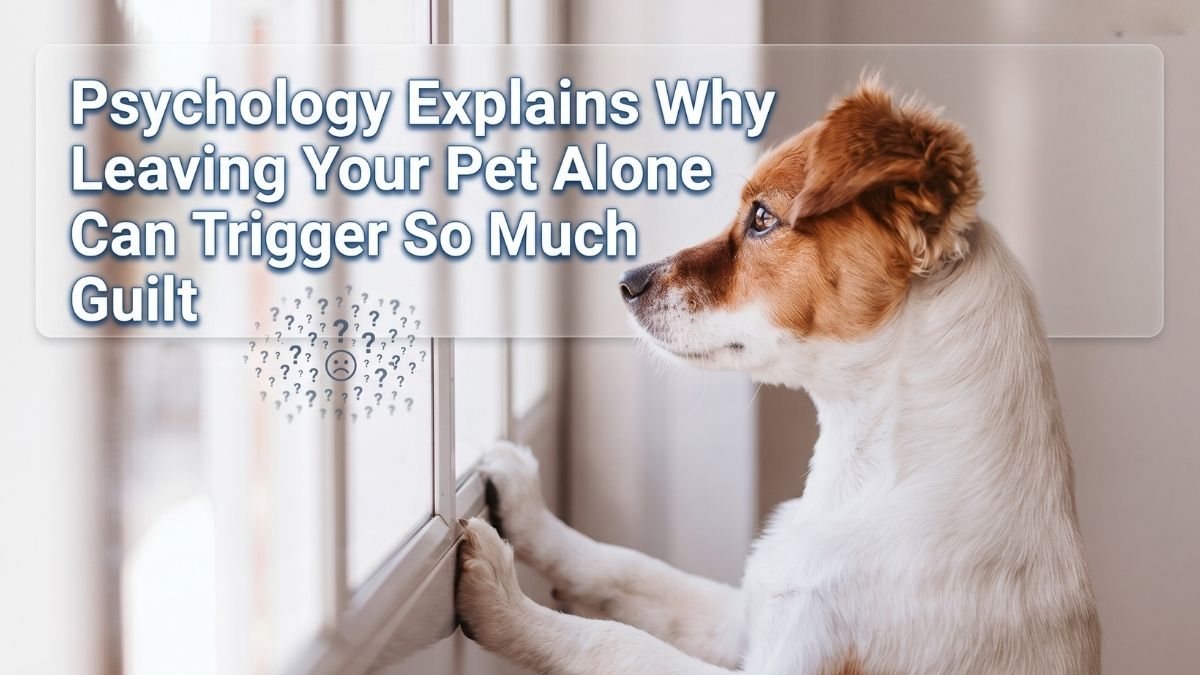
The keys rattle and the dog seems to notice immediately. Ears drop, the tail becomes still, and the familiar look can leave an owner wondering whether leaving the house is really the right thing to do.
Friends may dismiss the feeling. The dog will sleep, they might say. It is only a few hours. But psychology offers a more understanding explanation. Guilt about leaving a pet alone can be connected to the strength of the emotional bond between an owner and an animal.
Research suggests that companion animals can function as attachment figures, meaning they can provide comfort during stressful moments and a sense of security. For some owners, that bond can make separation emotionally difficult even when leaving the pet is perfectly reasonable.
Guilt
Research led by Lori Kogan at Colorado State University examined guilt among dog owners using a modified version of a scale originally designed to measure parenting guilt.
The study, published in Animals, included 592 American dog owners. Participants recorded an average guilt score of 44.75 out of 70. For comparison, studies using the original parenting scale have reported averages around 49.
The comparison does not mean caring for a dog is psychologically identical to raising a child. It does, however, suggest that some owners experience their responsibilities toward pets with considerable emotional intensity.
Among working participants, roughly one-third scored above an established cutoff for work-family conflict when “family” was replaced with “dog.” Time, attention and leaving the dog alone were among the strongest sources of guilt.
Some owners also reported changing their own behavior because of those feelings. Around 40 percent said they reduced social activities because of their dog, while about 35 percent reported giving their dog time at the expense of other family members.
Attachment
The strength of the human-animal bond helps explain why leaving a pet can feel emotionally significant.
Psychologist Sigal Zilcha-Mano and colleagues conducted two experiments examining whether pets could meet characteristics associated with attachment figures. In one experiment, 165 pet owners generated life goals. In another, 120 owners completed a stressful task while researchers monitored blood pressure.
The researchers found that having a pet present, or in some circumstances simply thinking about the pet, was associated with greater confidence in pursuing goals and lower physiological responses to stress.
Attachment relationships generally provide a secure base from which people can deal with challenges. Companion animals can serve some of these functions for their owners.
From that perspective, feeling reluctant to leave a pet is not necessarily irrational. The emotional response can be consistent with having formed a meaningful attachment.
Anxiety
Not everyone experiences pet-related guilt with the same intensity.
Research has found that attachment style can make a difference. A follow-up study reported that owners with more anxious attachment characteristics experienced considerably greater guilt about their dogs. Anxious attachment explained about 17 percent of the variation in guilt scores in that research.
Later work by Kogan and colleagues also found higher guilt scores among younger owners and women. Greater guilt was associated with higher measured anxiety and depression.
An interesting finding was that dog-related guilt did not strongly overlap with a general tendency to feel guilty. That suggests the emotion may be particularly connected to the relationship with the pet rather than simply reflecting a person’s overall personality.
Behaviour
Feeling guilty does not always mean that a dog is experiencing separation-related problems. However, sometimes the owner’s concern may correspond to genuine distress.
A large UK study involving 1,807 dogs examined separation-related behavior during 2020. Researchers found signs of the problem in 22.1 percent of dogs before the pandemic and 17.2 percent later in the year as household routines changed.
The figures also highlight why owners cannot always judge what happens after they leave. Some dogs show obvious signs such as barking, destruction or attempts to escape. Others may display quieter behaviors that are harder to notice.
The RSPCA advises that dogs should generally not be left alone for longer than four hours and notes that many dogs can find being alone difficult.
For an owner who is unsure, observing the dog when nobody is home can provide more useful information than guessing from the dog’s reaction at the door.
Homecoming
What happens when the owner returns may also matter.
The Generation Pup longitudinal study followed puppies through their early development. Researchers found an association between owners fussing over unwanted or anxious behavior when they returned home and later separation-related behavior in puppies.
Puppies whose owners responded to unwanted behavior at homecoming were reported to be six times more likely to develop separation-related behavior later. Puppies that slept for nine hours or more overnight in an enclosed space were less likely to develop the problem.
These findings are correlations, however, and do not establish that a particular owner response directly causes separation anxiety.
The broader training principle is to keep departures and arrivals calm. Making departures routine and avoiding an intense response to anxious behavior after returning can help prevent the separation from becoming an emotionally charged event.
Balance
The important distinction is between emotional attachment and actual distress.
An owner can feel guilty about leaving a dog even when the dog settles comfortably after the door closes. In that situation, the guilt may say more about the owner’s attachment than about the animal’s wellbeing.
On the other hand, persistent barking, pacing, destructive behavior, excessive drooling, attempts to escape or other signs of distress may indicate that the dog needs additional support. A veterinarian or qualified behavior professional can help assess those situations.
A simple camera can also provide useful information. Instead of imagining what happens after leaving, an owner can observe whether the dog settles, sleeps, plays or remains distressed.
Feeling guilty when leaving a pet alone can therefore be understood as part of a strong human-animal bond rather than automatically as an irrational reaction. Psychology shows that companion animals can become important attachment figures, and some owners are more sensitive to separation than others.
The most useful response is not to dismiss the feeling or automatically trust it, but to separate the owner’s emotional experience from the dog’s actual behavior. Sometimes the guilt reflects how much the relationship matters. Sometimes it also points to a problem worth addressing.
FAQs
Why do people feel guilty leaving pets alone?
Strong attachment can make separation emotionally difficult.
Can pets become attachment figures?
Yes. Research suggests pets can provide comfort and security.
Does pet guilt mean anxiety?
Not always. Guilt can occur without an anxiety disorder.
Can dogs experience separation-related behavior?
Yes. Some dogs show distress when left alone.
How can owners check a dog’s behavior?
A home camera can show how the dog behaves when alone.